What’s the Difference Between Mexican and International Health Insurance?
Short Answer
Mexican and international health insurance can both provide major medical protection, but they are built on very different insurance models.
Mexican health insurance is designed around Mexico’s healthcare and insurance system. Plans are issued in Mexican pesos, contracts and customer service are generally in Spanish, and claims may involve hospital tiers, physician and surgeon fee schedules, per-diagnosis deductibles, and co-insurance.
International health insurance is generally structured with fewer moving parts. Plans are issued in U.S. dollars, policy documents and customer service are available in English, deductibles are typically cumulative per year, and many plans have no co-insurance.
The difference isn't simply Mexico-only versus worldwide coverage—or which plan has the lower premium. It is how the insurance works, how a claim is calculated, and how much financial responsibility you may have when you actually need to use it.
What Is Mexican Health Insurance?
Mexican health insurance refers to health insurance plans issued by insurance companies established in Mexico and regulated by the Comisión Nacional de Seguros y Fianzas (CNSF).
These plans are designed specifically for the Mexican insurance and healthcare system. Their policy structures are unique to Mexico, premiums are quoted and paid in Mexican pesos, and policy documents and customer service are generally provided in Spanish.
Some of the major companies offering private health insurance in Mexico include GNP Seguros, AXA Seguros México, Allianz México, and MAPFRE México.
What Is International Health Insurance?
International health insurance, sometimes referred to as global or expat health insurance, refers to health plans offered by companies that serve members worldwide. These companies generally fall into two categories.
Some are domiciled in the United States, such as BCBS Global and Cigna Global. Others operate internationally but are domiciled offshore in jurisdictions such as Barbados, Puerto Rico, or the Cayman Islands. Examples include VUMI Group, Trawick International, Redbridge Health, and Morgan White Group.
International health plans are generally structured more like U.S. health insurance, with benefits that may include:
Inpatient hospitalization
Outpatient medical care
Preventive healthcare
Medical evacuation
Companies offer plan documentation and customer service in English, Spanish, and Portuguese.
Is International Health Insurance More Expensive Than Mexican Health Insurance?
It can be, but not always.
Mexican and international health insurance use different pricing, health plan, and claim structures. Comparing the premium alone doesn't necessarily tell you which option will cost less over time.
In 2026, the 16% IVA tax was passed on to members of Mexican health insurance plans, in addition to the age increases, medical inflation, and other factors that affect annual premiums.
As a result, Mexico-only does not automatically mean that Mexican plan premiums are lower than international plan premiums.
Currency exchange rates can also change the comparison. When the U.S. dollar was stronger against the Mexican peso, Mexican health insurance premiums could appear considerably less expensive when viewed in U.S. dollars. As the U.S. dollar has weakened against the peso, that difference has narrowed, making some international plans more competitive with Mexican plans.
This is why the better question isn't simply:
Which plan has the lower premium?
It's: What am I paying for the insurance, what benefits am I receiving, and what am I expected to pay when I have a claim?
Which Type of Health Insurance Is Better for Expats Living in Mexico?
Neither Mexican nor international health insurance is automatically better. An important consideration is how easily you can understand and use the plan, and how predictable your financial responsibility will be when you have a claim.
For many North Americans, clarity, language, ease of use, and predictability matter.
Mexican health insurance can be more complicated to use. Policy documents and customer service are generally in Spanish, contract language can be complex, and claims involve multiple moving parts, including hospital networks, physician and surgeon fee schedules, per-illness deductibles, co-insurance, and policy limitations.
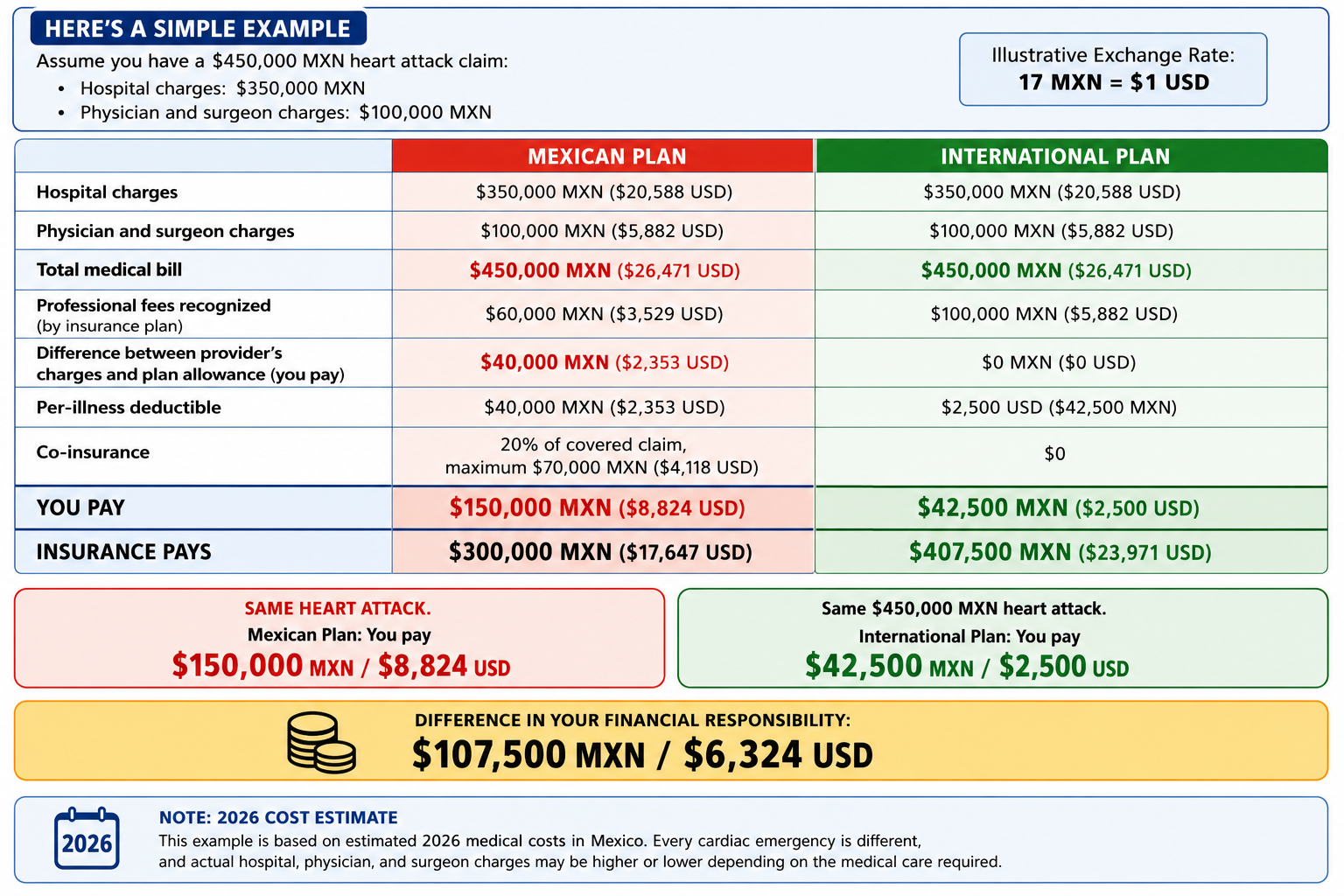
Mexican major medical plans also use established physician and surgeon fee schedules, called tabuladores, to determine how much the insurance company will recognize for professional medical services. These fee schedules may be lower than the amount a physician or surgeon actually charges. When that happens, you pay the difference in addition to any deductible and co-insurance.
International health insurance generally has fewer moving parts. Policy documents and customer service are available in English, contract language tends to be more straightforward, and your financial responsibility for a claim is easier to understand and calculate. International plans pay providers in U.S. dollars and use fee schedules based on U.S. UCR rates, which are generally higher than healthcare charges in Mexico.
The difference becomes much easier to understand when you see how the same medical claim could be calculated under each type of plan.
Same Medical Claim. Different Financial Responsibility.
This is why comparing premiums alone doesn't tell you how much your health insurance may ultimately cost. How the plan calculates a claim—and how much of that claim you may be responsible for paying—matters just as much.
How Do I Know Which Type Is Right for Me?
Choosing between Mexican and international health insurance requires looking beyond the premium and geographic coverage.
Start by asking yourself:
Am I eligible? Mexican and international companies have different underwriting requirements, and Mexican plans may have lower maximum ages for first-time applicants.
Do I understand the policy? Speaking conversational Spanish is very different from understanding insurance terminology, contractual language, and terms such as coaseguro and carta garantía.
Do I understand how my claims will be calculated? Deductibles, co-insurance, physician and surgeon fee schedules, hospital networks, and policy limitations can significantly affect your financial responsibility.
Who can I communicate with during a medical emergency? With a Mexican plan, your agent may become your primary English-language connection to the insurance company. Consider what happens if that person is unavailable when you need assistance.
Am I choosing Mexico-only coverage because it fits my healthcare strategy—or because I assume it will cost less? Geographic coverage is only one part of the decision. Premiums, plan mechanics, claim payments, and ease of use also matter.
There is nothing inherently wrong with choosing a Mexican or an international health insurance plan. The important question is whether you understand what you are choosing before you need to use it.
Not Sure Which Type of Health Insurance Is Right for You?
Understanding the differences between Mexican and international health insurance is the first step. The next is determining which options fit your health history, priorities, and long-term plans.